
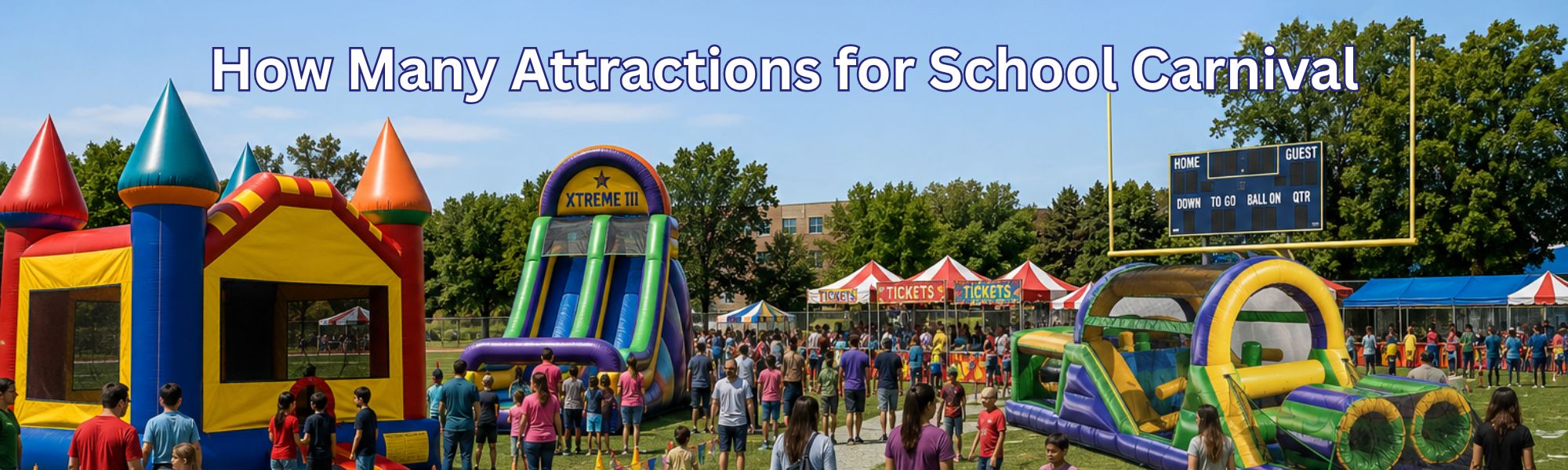
How Many Attractions Do You Need for a School Carnival?
You're planning a school carnival, and the question hits you around Week 3: how many inflatables, games, and activities do we actually need? Rent too few and you'll have 45-minute wait times and frustrated families. Rent too many and you've blown the budget on equipment that sits empty.
The answer isn't a magic number—it's a formula based on your expected attendance, event duration, age range, and venue layout. This guide walks you through the calculation, breaks down which attractions actually work at Garland-area school events, and shows you how to avoid the two biggest mistakes: underestimating turnout and overloading on the wrong equipment.
Whether you're organizing a spring fling for 200 families or a fall festival expecting 600+ guests, here's exactly how to build an attraction lineup that keeps kids engaged, lines moving, and volunteers sane.
Table of Contents
- The Capacity Formula: How Many Attractions You Actually Need
- Which Type of School Carnival Are You Planning?
- Attraction Breakdown by Event Size
- The Right Mix: Inflatables vs. Games vs. Activities
- Most Popular School Carnival Attractions in Garland
- How to Avoid Long Lines and Bottlenecks
- Common Mistakes (and How to Fix Them)
- Frequently Asked Questions
Which Type of School Carnival Are You Planning?
Your attraction needs change dramatically based on event size, format, and audience. Identify which scenario matches your situation:
Small Elementary Carnival
150-300 total attendees over 2-3 hours. Single grade level or small K-5 school. Gym or blacktop setup. Limited volunteer base. Budget-conscious.
Your priority: Maximum fun per dollar. Focus on 3-4 high-impact inflatables and 6-8 simple carnival games.
Mid-Size School Festival
400-600 total attendees over 3-4 hours. Full K-5 or middle school event. Field and parking lot space. Active PTA. Multiple fundraising stations.
Your priority: Capacity and variety. You need 6-8 inflatables, 10-12 games, plus specialty attractions to handle peak traffic.
Large Community Event
700+ total attendees over 4-5 hours. District-wide or community-open event. Full campus access. Sponsor support. Food trucks and live entertainment.
Your priority: Professional-grade experience. You need large event attractions, crowd flow management, and backup capacity.
The Capacity Formula: How Many Attractions You Actually Need
Forget guessing. Here's the math that actually works at real school events in Garland:
Base Formula: 1 major attraction per 40-60 expected attendees per hour
Example: 400 total guests over 3 hours = ~133 concurrent attendees = 3-5 inflatables minimum
But that's just your inflatable baseline. Now layer in the support attractions:
High-Throughput Inflatables
15-20 kids per 5-minute cycle
- Obstacle courses
- Giant slides
- Bounce combos
Quick-Turn Carnival Games
30-40 kids per hour per game
- Ring toss, basketball shootout
- Duck pond, milk bottle toss
- Bean bag toss
Specialty Attractions
10-15 participants per cycle
- Mechanical bull
- Photo booths
- Interactive inflatables (bungee run, joust)
Pro Tip: Add 20% more capacity than your math suggests. Schools always underestimate attendance. The event marketed for "300 families" routinely pulls 400+ once siblings, grandparents, and neighbors show up.
Attraction Breakdown by Event Size
Here's exactly what works for different scale events based on hundreds of Garland-area school carnivals:
Small Event Package
3-4 Inflatables:
- 1 obstacle course
- 1 slide
- 1-2 bounce houses
6-8 Carnival Games:
- Ring toss, duck pond, bean bag toss
- Basketball shootout, milk bottle
- Simple DIY stations (face painting, temporary tattoos)
Mid-Size Event Package
6-8 Inflatables:
- 2 obstacle courses (different sizes)
- 2 slides (dry or water depending on season)
- 2-3 bounce combos
- 1 interactive (bungee run or joust)
10-12 Carnival Games spread across venue
Add: Photo booth or specialty attraction
Large Event Package
10-15 Inflatables:
- 3+ obstacle courses
- 3-4 slides
- 4-5 bounce combos
- 2-3 interactive games
15+ Carnival Games in multiple zones
Add: Mechanical rides, rock walls, zip lines, professional photo setup, tent coverage
The Right Mix: Inflatables vs. Games vs. Activities
The mistake most event planners make: going all-in on inflatables and forgetting that half your attendees are waiting in line at any given moment. You need a balanced ecosystem that keeps everyone engaged.
The 50/30/20 Rule
50% Inflatables: Your main draw. These create the visual impact and handle the bulk of your attendee-hours. Focus budget here.
30% Quick-Turn Games: Carnival games that cycle kids through in 2-3 minutes. These absorb wait-time energy and give younger siblings something to do while older kids are on the obstacle course.
20% Passive/Specialty: Photo booths, prize redemption tables, craft stations, face painting. Low-throughput but high-engagement activities that give families a reason to linger.
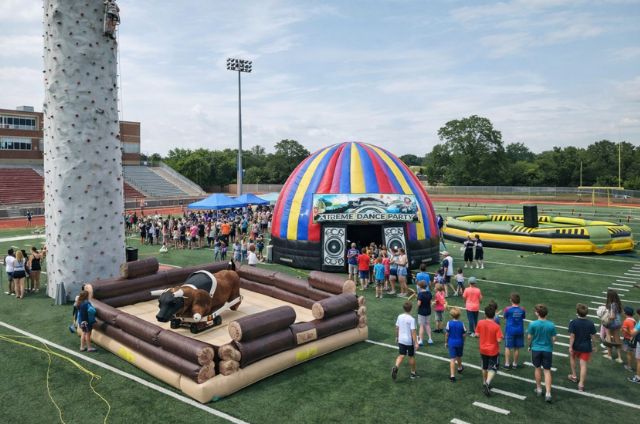
Professional-grade attractions create the "wow factor" that drives attendance and fundraising success
Reality Check: Your budget will be 60-70% inflatables, 20-25% games, 10-15% specialty. That's expected.
But if you allocate your physical space the same way, you'll have bottlenecks. Spread games and activities across the entire venue to distribute foot traffic.
Most Popular School Carnival Attractions in Garland
Based on actual booking data from hundreds of North Texas school events, here's what consistently delivers the highest engagement:
🏆 Obstacle Courses
Why they work: Appeal to all ages K-8. Competitive element keeps kids coming back. High throughput (15-20 kids per round).
Best choice: 30-40 ft models for elementary, 50+ ft for middle school or all-ages events.
🎯 Interactive Inflatable Games
Why they work: Create spectator moments. Parents pull out phones. Kids line up to challenge friends.
Bungee run, jousting arena, basketball shootout combos—anything with a competitive or skill-based element.
🎪 Traditional Carnival Games
Why they work: Nostalgia for parents. Low-pressure fun for shy kids. Quick cycles = no long waits.
Ring toss, duck pond, and milk bottle toss outperform elaborate setups every time.
Pro Tip: Book your obstacle courses and slides first—these are highest demand and book out 6-8 weeks ahead for spring carnival season (March-May). Fill in around them with games and smaller inflatables.
How to Avoid Long Lines and Bottlenecks
Nothing kills carnival energy faster than 20-minute waits. Here's how professional event coordinators manage flow:
✓ Strategies That Work
- Spread high-demand attractions apart — Don't cluster all inflatables in one zone
- Assign line managers — Dedicated volunteers who call out wait times and suggest alternatives
- Implement timed sessions — 5-minute rotations announced with a whistle or bell
- Create "while you wait" activities — Small games positioned in queue areas
- Schedule distraction events — Raffles, dance-offs, or announcements every 20 minutes pull crowds away from attractions briefly
✗ Common Line Problems
- No visible queue structure — Use cones, ropes, or chalk lines
- Allowing "just one more turn" — Enforce rotation rules from minute one
- Age-mixing on competitive attractions — Separate K-2 from 3-5 from middle schoolers
- Understaffing inflatables — Every inflatable needs a dedicated monitor, not roaming coverage
- Placing food trucks near inflatables — Creates dangerous congestion and sticky equipment
Garland-Specific Tip: If you're using school fields during March-May, have a rain contingency that includes moving quick-set games under covered areas. Afternoon pop-up storms are common. Having 4-6 portable games that work under gym overhangs saves the event when weather turns.
Common Mistakes (and How to Fix Them)
🚩 Red Flag #1: "We'll just rent what we can afford"
The problem: You end up with a random mix that doesn't serve your actual attendance or age range.
Fix it: Start with capacity math, then find budget. If you can't afford enough attractions for your expected crowd, scale down your marketing or extend the event hours to spread attendance.
🚩 Red Flag #2: Booking too late
The problem: Spring carnival season (March-May) books solid 6-8 weeks out. You're left with slim pickings or premium prices.
Fix it: Lock your date and reserve core inflatables by January for spring events, by July for fall festivals. Add smaller items later as budget allows.
🚩 Red Flag #3: Ignoring setup logistics
The problem: You book 8 inflatables without confirming you have 8 separate 20-amp circuits, adequate clearance, or vehicle access for delivery trucks.
Fix it: Walk your venue with your rental company 2-3 weeks before the event. Identify power sources, measure spaces, confirm anchor points. Most delivery issues are preventable with a 15-minute site check.
Need help with site planning? Call (469) 600-2291 — we've set up hundreds of school events and can walk through your specific venue challenges.
🚩 Red Flag #4: No backup plan for weather
The problem: You've rented all outdoor inflatables for an April event in Texas. It storms. You have no Plan B.
Fix it: Include 2-3 smaller inflatable games that can move under covered walkways or gym spaces. Book tent coverage for at least your game stations. Confirm your rental company's weather policy in writing.
The Planning Timeline That Actually Works
Here's the realistic timeline from successful Garland-area school events:
8-10 Weeks Before
- Lock date and venue
- Calculate expected attendance
- Book 2-3 core inflatables
- Reserve tables and chairs
4-6 Weeks Before
- Finalize full attraction list
- Recruit volunteers and assign stations
- Site walkthrough with rental company
- Order prizes and supplies
2 Weeks Before
- Confirm delivery window and setup crew
- Create site map with attraction placement
- Brief volunteers on rotation/line management
- Verify power and water access
Day Before
- Mark setup locations with spray paint or cones
- Confirm arrival time with delivery crew
- Prep volunteer shift assignments
- Check weather and activate Plan B if needed
Frequently Asked Questions
How many inflatables are enough for a school carnival? +
Plan for one major inflatable per 40-60 expected attendees per hour. A school carnival expecting 400 people over 3 hours (roughly 133 concurrent guests) needs 3-5 inflatables minimum to keep wait times under 10 minutes. Add obstacle courses, carnival games, and interactive attractions to spread the crowd and maximize participation. Most successful mid-size events (400-600 guests) use 6-8 inflatables supported by 10-12 quick-turn games.
How do you avoid long lines at a school carnival? +
Distribute high-demand attractions across your event space rather than clustering them. Mix quick-turn games (ring toss, basketball shootout) with longer-duration inflatables. Assign dedicated volunteers to manage lines and enforce 5-minute rotation cycles. Schedule staggered activities like raffles, performances, or announcements every 20 minutes to periodically pull crowds away from attractions. Most importantly, rent adequate capacity—undershooting on attraction count is the #1 cause of line problems.
Which attractions are most popular at school carnivals? +
Obstacle courses generate the highest engagement across all age groups, followed by inflatable slides, bounce houses with basketball hoops, and interactive carnival games like milk bottle toss or duck pond. For Garland-area events specifically, competitive inflatables (bungee run, jousting arena) and mechanical attractions create spectator moments that parents share on social media, driving word-of-mouth for future events. Classic carnival games outperform elaborate setups because they cycle kids quickly and work for all skill levels.
How far in advance should you book carnival attractions? +
Book 6-8 weeks ahead for spring carnival season (March-May) when demand peaks across North Texas schools. Popular obstacle courses and large slides often sell out 8-10 weeks before peak weekends. For fall festivals (September-October), 4-6 weeks is typically sufficient. Lock your core attractions first, then add smaller games and specialty items as your budget and planning solidify. Last-minute bookings (2 weeks or less) severely limit your selection and often come with premium pricing.
What's the best mix of inflatables versus games? +
Follow the 50/30/20 rule: 50% major inflatables, 30% quick-turn carnival games, 20% passive/specialty activities. This creates a balanced ecosystem where kids waiting for inflatables have immediate alternatives. Your budget will naturally skew toward inflatables (they're the main draw), but spreading carnival games across the venue prevents bottlenecks and keeps younger siblings engaged. Add photo booths, craft stations, or face painting as low-throughput activities that give families reasons to linger and maximize your per-family time on site.
Do you need different attractions for different age groups? +
Yes—mixing ages on competitive inflatables creates safety issues and frustration. For K-5 events, designate one obstacle course or slide for K-2, another for 3-5. Middle school carnivals need larger, more challenging attractions (50+ ft obstacle courses, taller slides, mechanical rides). Multi-age community events work best when you zone attractions by intensity level and post clear age guidelines. Carnival games and bounce houses naturally accommodate all ages when you enforce reasonable participant limits per cycle.
What if weather threatens your outdoor carnival? +
Build weather contingency into your initial plan. Include 2-3 smaller inflatable games that can move under covered walkways or gym spaces if storms hit. Book tent coverage for at least your game stations and food areas. Confirm your rental company's weather cancellation policy in writing—most offer reschedule options for severe weather but not light rain. For spring events in Garland (March-May), afternoon pop-up storms are common enough that covered backup zones aren't optional; they're essential planning.
Ready to Plan Your Best School Carnival Yet?
You don't need to figure out capacity math, logistics, and equipment selection alone. We've helped hundreds of Garland-area schools create memorable, stress-free carnivals that kids talk about all year.
No pressure. No pitch. Just a real conversation about what will work for your specific event, space, and budget.
Serving schools, churches, and community organizations across Garland and surrounding areas