
How to Choose the Right Inflatable for Your Child's Age
You've got kids ranging from 3 to 10 at the same party, and you're staring at rental options wondering if one inflatable can actually keep everyone safe and entertained. Age-appropriate inflatable selection isn't just about fun—it's about preventing injuries, avoiding boredom, and making sure your rental investment actually gets used.
The right inflatable matches physical abilities, attention spans, and safety needs for your specific age group. The wrong one means toddlers intimidated by tall slides, older kids bored in baby bouncers, or—worse—size mismatches that create collision risks.
Here's exactly how to match inflatables to ages, what to avoid, and how to handle mixed-age groups in Garland parties where age ranges can span a decade.
Table of Contents
- Which Type of Party Planner Are You?
- Best Inflatables for Toddlers (Ages 1-3)
- Preschool & Kindergarten (Ages 4-5)
- Elementary Age Kids (Ages 6-9)
- Preteens & Tweens (Ages 10-12)
- Handling Mixed-Age Groups Safely
- Red Flags: When an Inflatable Is Wrong for Your Group
- Age-Based Safety Rules Parents Miss
- Frequently Asked Questions
Which Type of Party Planner Are You?
Find yourself below—your situation determines which inflatables work and which create headaches. You can also check out our bounce party ideas!
🎂 Single Age Group
You're planning a 5th birthday with mostly kindergarteners, or a tween party where everyone's 10-12.
Your advantage: You can choose highly age-optimized inflatables without compromising. Look for features that challenge this specific developmental stage.
👨👩👧👦 Mixed Siblings
You've got a 3-year-old, 7-year-old, and 10-year-old, and everyone needs to feel included.
Your challenge: One inflatable rarely works for this span. You need combo units with separate zones or strategic rental combinations.
🏫 School/Church Event
You're organizing a field day, festival, or community event with 50+ kids spanning ages 4-12.
Your priority: High throughput, multiple activity zones, and inflatables that naturally separate age groups through design.
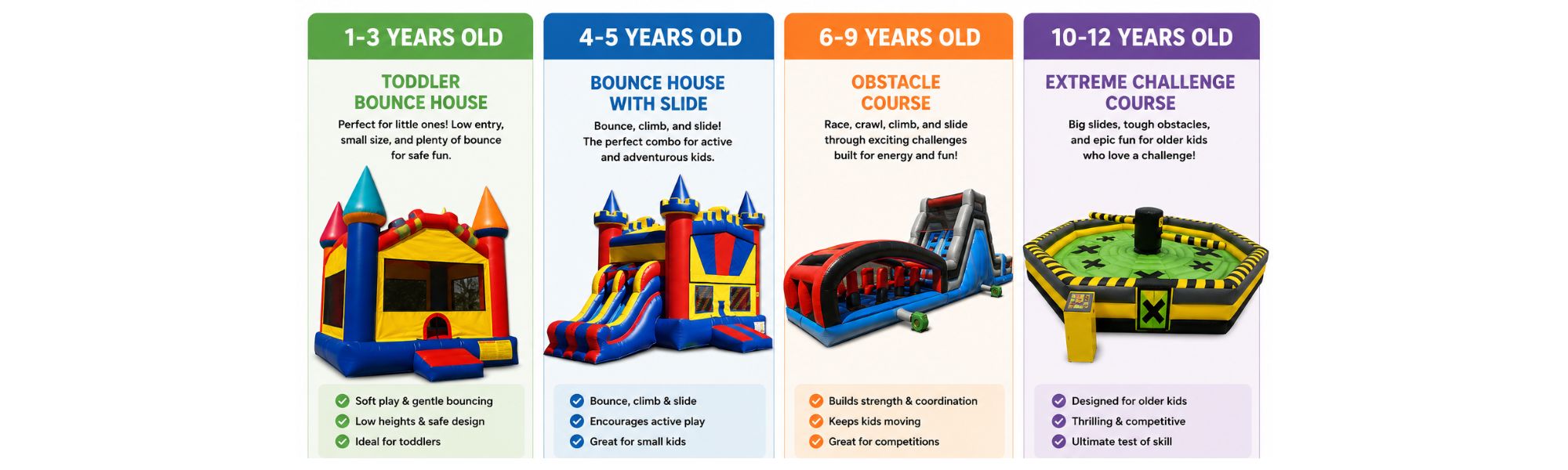
Best Inflatables for Toddlers (Ages 1-3)
Developmental reality: Toddlers are learning gross motor skills—balance, climbing, jumping with both feet. They have short attention spans (5-10 minutes per activity) and low impulse control around bigger kids.
Golden rule for toddlers: Choose inflatables where falls happen close to the ground and exits are easy to supervise. Tall slides and complex climbing structures create fear and injury risk.
What Works for Toddlers
✓ Small bounce houses (under 10x10)
Low entry, netted sides, flat bouncing surface. No obstacles inside.
✓ Mini combo units with gentle slides
Slide exit under 4 feet high, wide slide surface, gradual incline.
✓ Toddler ball pits
Enclosed, low-stimulation, easy parent access for quick rescues.
What to Avoid
✗ Tall slides over 6 feet — Creates fear and hard falls
✗ Basketball hoops inside bounce area — Collision magnet for uncoordinated toddlers
✗ Obstacle courses with climbing walls — Beyond motor skill development at this age
✗ Water slides — Drowning risk even in shallow water with toddlers
"The 3-foot rule: If your toddler can't safely fall from the height of the inflatable feature, it's too tall for this age group."
Preschool & Kindergarten (Ages 4-5)
Developmental leap: Better balance, longer attention spans (15-20 minutes), and they're starting to enjoy mild challenges and imaginative play themes.
This is the sweet spot for themed bounce houses—castles, princess designs, superhero units. The visual theme matters because it drives imaginative play, extending how long they stay engaged.
↓ What Makes This Age Easy
✓ Can follow simple safety rules
✓ Interested in slides and small climbing features
✓ Theme-driven—characters extend play time
✓ Can play cooperatively in small groups
↑ What Makes This Age Challenging
✗ Still collision-prone with bigger kids
✗ Overconfident on tall slides they can't handle
✗ Meltdowns when overwhelmed by crowd size
✗ Some still need help with slide exits
Ideal Inflatables for 4-5 Year Olds
- Combo units with 6-8 foot slides — Gives them a challenge without danger
- Themed bounce houses (10x10 to 13x13) — Castle, princess, superhero designs
- Mini obstacle courses — Pop-up obstacles, small tunnels, easy climbing walls
- Bounce house + slide combo — Two activities in one footprint
💡 Pro Tip:
For preschool parties, theme match matters more than size. A 10x10 Disney Princess bouncer will get more use than a generic 15x15 unit because it fuels imaginative play.
Elementary Age Kids (Ages 6-9)
Peak inflatable years. These kids have the coordination for complex inflatables, the attention span for longer play sessions (30+ minutes), and the social skills to handle mixed-group play.
This age wants multiple activity zones, competitive elements, and physical challenges. A basic bounce house won't hold their attention—they need slides, climbing, basketball, obstacle races.
Most Popular for 6-9 Year Olds
1. Obstacle courses — Timed races, competitive play
2. Combo units with tall slides — 10-12 foot slides are thrilling but safe
3. Interactive game inflatables — Basketball shootout, axe throw, sports challenges
4. Water slides (summer) — Splash pools, dual-lane racing slides
What This Age Needs
Physical challenge — Climbing, racing, jumping competitions
Variety — Multiple activities in one inflatable prevents boredom
Social play — Design that encourages group games, not solo bouncing
"Cool" factor — Themes shift from characters to sports/adventure
Size Matters at This Age
Elementary kids are bigger, bouncier, and more energetic. Small inflatables feel cramped and limit how many can play safely.
- 15x15 combo units — Good for 8-10 kids at once
- 30-40 foot obstacle courses — Handles racing, multiple simultaneous users
- Dual-lane slides — Reduces wait time, adds competitive element
⚠️ Watch out:
Elementary kids often want to play rough—wrestling, dog-piling, collision games. Combo units with separate zones reduce injury risk by giving aggressive play its own space away from quieter bouncers.
Preteens & Tweens (Ages 10-12)
The "am I too old for this?" age. Many tweens still love inflatables, but they need designs that don't feel babyish and activities that feel like legitimate physical challenges.
This age responds to competition, physical difficulty, and social dynamics. They want inflatables that feel like obstacle courses or game show challenges, not kids' party decorations.
What Works for 10-12 Year Olds
Extreme obstacle courses
40+ feet, multiple climbing walls, competitive racing lanes. Feels like American Ninja Warrior.
Tall water slides
15-18 foot slides with splash pools. Fast, thrilling, visually impressive for Instagram moments.
Interactive game units
Sports challenges, Wipeout-style sweeper arms, battle inflatables with jousting or boxing.
Theme Shift: From Characters to Challenges
At 10-12, kids stop caring about princess castles and superhero themes. They want designs that look sporty, competitive, or extreme—think black and neon color schemes, challenge course aesthetics, game show vibes.
💡 Pro Tip:
If your tween is "too cool" for a bounce house, reframe it as a challenge course. "Who can complete the obstacle course fastest?" beats "Let's bounce" every time for this age.
Weight Limits Become Real
Most inflatables max out at 800-1000 lbs total capacity. With larger tweens, you hit capacity faster than you think.
Standard rule: 4-6 tweens max at once in a 15x15 unit. Obstacle courses handle more because kids spread out along the length rather than bouncing in one space.
Always ask rental companies about weight limits for this age group—some inflatables are reinforced for heavier users.
Handling Mixed-Age Groups Safely
Here's the hard truth: one inflatable rarely works well for ages 3-12 simultaneously. Size mismatches create collision injuries, boredom, and tears.
But with the right setup and supervision strategy, you can make mixed-age parties work without renting four different inflatables.
Best Inflatable Types for Mixed Ages
#1 Best: Combo Units with Separate Zones
Bounce area + slide exit + separate climbing wall = natural age separation.
Why it works: Little kids stay in the bounce zone. Big kids gravitate to slides and climbing. Different features = different skill levels self-sort.
#2 Good: Two Smaller Inflatables
One toddler-friendly bounce house + one obstacle course for older kids.
Why it works: Physical separation eliminates collision risk. Each age group gets optimized experience. Often costs less than one massive combo.
#3 Okay: Wide Obstacle Courses
8-10 foot width gives enough space for size separation within the same inflatable.
Why it works: Kids spread out along the length rather than bouncing in one small area. Still requires active supervision to prevent size mismatches at climbing walls.
Supervision Strategy for Mixed Ages
Group by size, not age. A tall, athletic 7-year-old can safely play with 10-year-olds. A small 5-year-old needs to stay with the younger group even if they're technically "old enough."
Rotation schedule that works:
- 0-15 min: Ages 3-5 only (little kids get first turn when energy is highest)
- 15-30 min: Ages 6-9 only
- 30-45 min: Ages 10-12 only
- 45 min+: Open play with enforced capacity limits (stay at 70% capacity to allow space)
⚠️ Critical rule:
Never exceed 70% of stated capacity during mixed-age play. Full capacity + size mismatches = guaranteed collisions. Leave buffer room so big kids can avoid landing on small kids.
Red Flags: When an Inflatable Is Wrong for Your Group
Watch for these warning signs when evaluating rentals:
🚩 Slide taller than oldest kid's comfort level
If the birthday child is scared of the slide, half the guests will be too. Choose one tier down.
🚩 Weight limit below your guest total
Calculate average kid weight × 60% of guest count. If it exceeds inflatable capacity, it's too small.
🚩 Complex climbing that requires upper body strength
Kids under 7 lack the strength for rock wall grips. They'll get stuck halfway and need rescue.
🚩 Single entry/exit in crowded setup
Bottlenecks cause pile-ups. For 10+ kids, you need dual entry points or wide openings.
🚩 Worn-out netting or visible repairs
Safety mesh is the only thing preventing falls. Patched netting = rental company cutting corners.
🚩 Water slide without ground stakes shown in photo
Water slides must be staked. If the rental company's photos show sandbags only, pass.
⛔ Absolute deal-breaker:
Any inflatable with sharp corners, exposed metal, or hard plastic features inside the bounce area. These aren't consumer-grade safety violations—they're emergency room visits waiting to happen.
Age-Based Safety Rules Parents Miss
These aren't in the rental contract, but they're the difference between a great party and a hospital trip.
For Toddlers (1-3)
✓ One adult inside the inflatable at all times
✓ Remove shoes, glasses, jewelry before entry
✓ Maximum 3 toddlers at once, regardless of stated capacity
✓ No older siblings "helping"—size mismatch risk
For Elementary (6-9)
✓ Adult stationed at slide exit (not entry)
✓ No flips, wrestling, or piling on other kids
✓ Slide one at a time—wait until previous kid clears
✓ Water break every 20 minutes (dehydration happens fast)
For Preschool (4-5)
✓ Adult within arm's reach of entrance
✓ Teach slide position: feet first, sitting down
✓ No running inside—bouncing only
✓ Help kids exit if they freeze at top of slide
For Tweens (10-12)
✓ Enforce weight limits strictly—they're heavier than they look
✓ Watch for showing off (dangerous stunts to impress friends)
✓ No phones/cameras inside—distraction injuries are common
✓ Check blower every 30 minutes in Texas heat
💡 Garland-specific tip:
In Garland's summer heat (95-105°F), inflatables become slip hazards from sweat. Rotate kids out every 15 minutes during July-August parties, and have a shaded water station within sight of the inflatable.
Frequently Asked Questions
Which inflatable is best for toddlers? +
For toddlers ages 1-3, look for low-profile bounce houses under 8 feet tall with gentle slopes, no tall slides, and enclosed sides. Mini combo units, small bounce houses with soft landings, and toddler-specific ball pits work best. Avoid units with steep climbs, tall slides over 4 feet, or basketball hoops that create collision risks. The inflatable should allow an adult to step inside easily for supervision, and falls should happen close to the ground—ideally no higher than 2-3 feet at any point.
What inflatables do older kids enjoy? +
Kids ages 8-12 love challenge-based inflatables like obstacle courses, combo units with tall slides (10-12 feet), interactive games with basketball hoops or pop-up obstacles, and water slides during warm months. They want physical challenges, competitive elements, and visually exciting designs with multiple activity zones. Basic bounce houses bore this age group quickly—they need units that feel like game show challenges or ninja courses. Extreme obstacle courses (40+ feet), dual-lane racing slides, and battle inflatables with jousting features are consistently popular with this age range.
Can different ages play together safely? +
Yes, with the right inflatable and supervision. Combo units with separate zones work best—younger kids in the bounce area, older kids on slides. Look for units with 8-10 foot width that allow space separation. Always enforce size-based supervision: group kids by size, not just age (a tall 7-year-old can safely play with 10-year-olds). Rotate play areas every 15 minutes, and keep maximum capacity at 70% instead of 100% to reduce collision risk. Never allow mixed-age play during the first 15 minutes—let younger kids have the inflatable first when their energy is highest and before bigger kids establish rough play patterns.
How do I know if an inflatable is too advanced for my child's age? +
Watch for these signs: slides taller than the child's comfort level, climbing features requiring upper body strength they don't have, or complex obstacles that cause them to freeze mid-activity. A good test: if the birthday child looks scared or hesitant in the rental photos, choose one tier down. For toddlers, anything requiring climbing over 3 feet is too advanced. For preschoolers, rock wall grips and steep ladder climbs are too difficult. For elementary kids, extreme obstacle courses designed for tweens will frustrate them. The inflatable should challenge them slightly without creating fear—if they need adult rescue within the first 5 minutes, it's too advanced.
Should I rent two smaller inflatables or one large combo unit? +
For mixed-age parties (age span of 5+ years), two smaller inflatables often work better and cost about the same. Rent a toddler-friendly bounce house for ages 1-5 and an obstacle course or combo for ages 6-12. This eliminates collision risk, gives each age group an optimized experience, and reduces supervision stress. For single-age parties or tight budgets, one large combo unit with separate zones (bounce area + slide + climbing wall) works well. The combo approach requires more active supervision to enforce size separation, but it's adequate if you're rotating age groups on a schedule rather than allowing free-for-all play.
What's the minimum age for water slides? +
Minimum age 5 for water slides, and only with constant adult supervision at the splash pool. Kids under 5 lack the coordination to control their slide speed and body position, making water entry dangerous. Even shallow splash pools (6-8 inches) pose drowning risk for this age if they land face-down and panic. For ages 5-7, choose water slides under 10 feet tall with gradual slopes. For ages 8+, standard 15-18 foot water slides are appropriate. Always station an adult at the bottom of the slide, not the top—exit supervision prevents water-related injuries. In Garland's summer heat, water slides are tempting, but age restrictions exist for real safety reasons, not liability theater.
How many kids can safely use an inflatable at once? +
Follow the 70% rule: use only 70% of the stated maximum capacity to allow movement space and reduce collision risk. For a 15x15 bounce house rated for 8 kids, keep it to 5-6 maximum. For toddlers, never exceed 3 at once regardless of stated capacity—they're unpredictable and need more space per child. For tweens and teens, calculate based on weight: average kid weight × number of kids should not exceed 70% of the inflatable's total weight limit (usually 800-1000 lbs). Obstacle courses handle more simultaneous users because kids spread along the length, but still enforce entry limits to prevent bottlenecks at climbing walls.
Ready to Book the Perfect Age-Matched Inflatable?
We'll help you choose the right inflatable for your child's age, guest list, and party setup—no pressure, just honest guidance from local Garland party pros.
All our inflatables are cleaned, inspected, and safety-checked before every rental. On-time delivery guaranteed. Check out all bounce house ideas!
Book OnlineQuestions? Call us: (469) 600-2291