
Bounce House vs. Obstacle Course: Which One Is Right for Your Event?
You're planning a celebration in Garland, and you know you want an inflatable rental that'll keep kids entertained. But when you start browsing, the options split into two camps: classic bounce houses and competitive obstacle courses. Both get kids moving, both create unforgettable moments, but they deliver completely different experiences.
The right choice depends on your guest list, backyard space, and what kind of energy you want at your party. A bounce house might be perfect for your five-year-old's birthday, but totally wrong for a middle school graduation bash. An obstacle course could be the star of your church festival, but overkill for a small family gathering.
This guide breaks down exactly how these two party powerhouses compare, so you can book with confidence and create the celebration your guests will actually remember.
What's in This Guide
- Which type of event are you planning?
- When bounce houses are the clear winner
- When obstacle courses steal the show
- Age-by-age breakdown: what works when
- Space requirements in Garland backyards
- Which holds attention longer (and why)
- When renting both makes perfect sense
- Side-by-side feature comparison
- Your most common questions answered
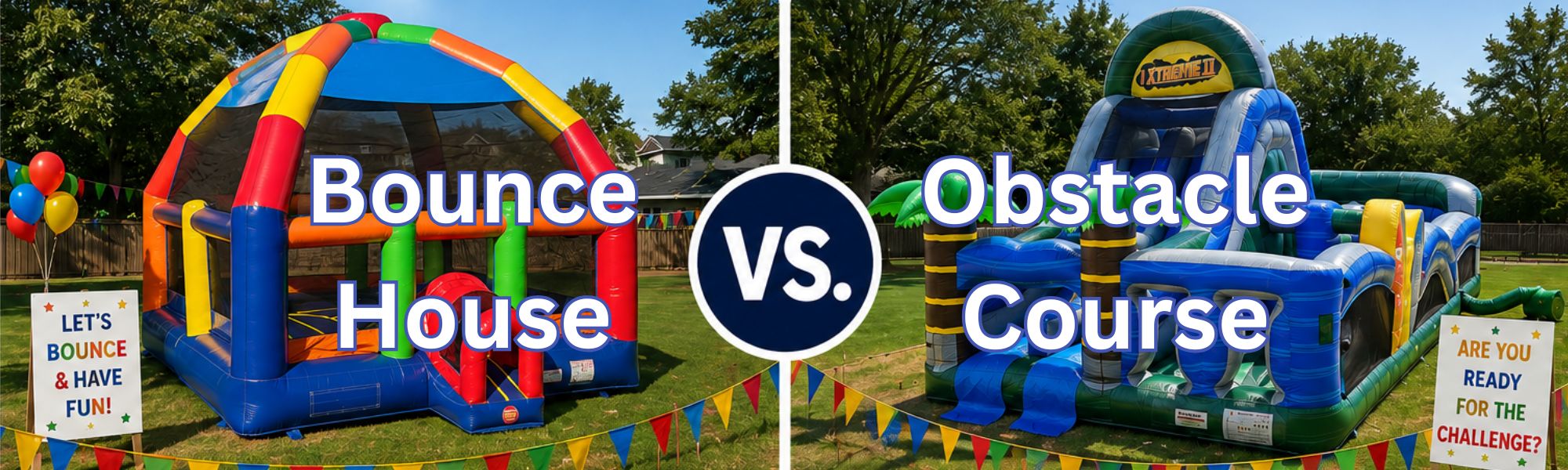
Which Type of Event Are You Planning?
Not all celebrations need the same kind of energy. Let's figure out which category your event falls into.
🎂 Small Birthday Party
8-15 kids, backyard setting, 2-3 hour party
You need something that works for mixed ages, fits your yard, and keeps kids entertained while you handle cake and presents. Bounce houses are your best bet — kids rotate in and out naturally, younger siblings can play safely, and you're not coordinating races or tournaments.
🏆 Competitive Celebration
Graduation, team party, tween birthday, 20+ guests
Older kids want a challenge, not just jumping. They'll create races, keep score, and compete for hours. Obstacle courses dominate when your guests are 8+ and you have the space for a 30-40 foot setup.
🎪 Community or School Event
Church festival, school carnival, corporate family day
You're entertaining 50-200 people with massive age ranges. Rent multiple units — a bounce house for toddlers to 7-year-olds, an obstacle course for 8-14, and maybe a combo unit for variety. This prevents bottlenecks and keeps everyone moving.
When Bounce Houses Are the Clear Winner
Bounce houses have been the birthday party MVP for decades because they solve specific problems beautifully. Here's when they're absolutely the right call.
Perfect for Younger Kids (Ages 3-8)
Preschool and early elementary kids don't need competition or structure — they need space to burn energy and use their imagination. A bounce house becomes a castle, a spaceship, a trampoline park. Kids jump, laugh, tumble, and create their own games without any adult direction.
At this age, obstacle courses are often too physically demanding or intimidating. The climbing walls, tunnels, and racing format overwhelm younger children who just want to bounce.
Pro Tip: If you have a mix of ages (like a 5-year-old's party with 10-year-old siblings), a themed bounce house with a small slide attachment keeps everyone engaged. The little ones bounce, the big kids slide and do tricks.
Ideal for Smaller Garland Backyards
Most Garland homes have yards in the 30-50 foot range. A standard 13x13 bounce house fits perfectly, leaving room for tables, a grill, and walking space. You need about 15x15 feet of flat, clear area — totally doable in most residential setups.
Obstacle courses, by contrast, need 25-40 feet of length plus side clearance. That works great at a park or church parking lot, but it's tight in a typical backyard.
Lower Supervision Needs
Once kids are bouncing, your job is mostly done. Set a simple rule (no shoes, no food inside, 6-8 kids max at a time) and let them play. Parents can relax, socialize, and handle other party tasks without constantly monitoring races or cheering competitions.
Obstacle courses naturally draw spectators and require more adult presence to organize heats, time races, and keep the competitive energy positive.
Budget-Friendly for Smaller Guest Lists
If you're hosting 8-12 kids, a single bounce house delivers maximum fun per dollar. Kids rotate in and out naturally, so you're not dealing with long wait times or bored guests. One unit keeps everyone happy for the entire party.
For that same group size, an obstacle course can feel underutilized — you're paying for 40 feet of inflatable when kids cycle through in 90 seconds and then wait for the next turn.
When Obstacle Courses Steal the Show
Obstacle courses transform a party from "fun" to "legendary" when you have the right crowd and setup. Here's when they're worth every square foot.
Older Kids Demand Competition (Ages 8-14)
Pre-teens and tweens get bored in bounce houses after 15-20 minutes. They need a challenge, not just bouncing. An obstacle course gives them something to master: climb the wall faster, navigate the tunnels without touching, beat their friend's time by two seconds.
Kids naturally organize tournaments, keep track of personal bests, and replay the course dozens of times trying to improve. That competitive energy keeps them engaged for 2-3 hours straight — way longer than passive bouncing.
High-Traffic Events Need Throughput
At a church festival, school carnival, or corporate family day, you're not hosting 12 kids — you're entertaining 50-200 people over 3-4 hours. Obstacle courses move kids through quickly (60-90 seconds per run) while creating a spectator-friendly event that draws a crowd.
Parents watch, cheer, record videos, and kids see the action from across the field and run over to join. A bounce house doesn't create that same visual excitement or event energy.
Important: For obstacle courses to work well, you need a designated adult or teen volunteer managing the line, starting each heat, and keeping things fair. Without that structure, arguments and chaos replace the fun.
Team-Building and Group Energy
Obstacle courses naturally create camaraderie. Kids cheer each other on, form relay teams, challenge adults to races, and bond over shared accomplishments. It's social by design, not solitary.
This makes them perfect for graduation parties (classmates competing together), sports team celebrations (natural team spirit), and youth group events where you want kids interacting, not just playing separately.
They Look Incredible (and Parents Love the Photos)
A 40-foot obstacle course is a statement piece. It dominates your yard or venue, creates an instant "wow" when guests arrive, and delivers action-packed photos and videos. Parents love posting kids mid-climb or sliding out the exit chute.
Bounce houses are fun, but they don't create the same visual impact or social media moments. If you're throwing a milestone celebration and want it to feel big, obstacle courses deliver that energy.
Age-by-Age Breakdown: What Works When
Not every age group interacts with inflatables the same way. Here's the honest breakdown based on thousands of Garland parties.
Toddler Zone
Best choice: Small bounce house only
Toddlers need safe, contained bouncing with no obstacles. They lack the coordination for climbing walls or tunnel navigation. A simple bounce house with low walls and soft landings is perfect. Obstacle courses are too advanced and can be scary.
Sweet Spot for Bounce Houses
Best choice: Bounce house (possibly with slide)
This age loves imaginative play and has the stamina to bounce for 30-45 minutes at a time. They're developing coordination but don't need competitive challenges yet. A bounce house with a slide attachment adds variety without overwhelming them.
Transition Zone
Best choice: Obstacle course or combo unit
These kids want more challenge than bouncing but aren't too cool for fun. Obstacle courses hit the perfect balance — physical activity, friendly competition, and group energy. They'll race each other for hours and genuinely love it.
Obstacle Course Obsessed
Best choice: Obstacle course only
Bounce houses feel babyish to pre-teens and teens. They want competition, speed, and something Instagram-worthy. Obstacle courses let them show off, compete with friends, and stay engaged without feeling like they're at a little kid's party.
Mixed Age Strategy: If you're hosting siblings or cousins with a 4+ year age gap, rent both a bounce house and obstacle course. The little ones stay happy bouncing, the big kids dominate the obstacle course, and nobody's bored or overwhelmed.
Space Requirements in Garland Backyards
Even the perfect inflatable won't work if it doesn't fit your space. Here's what you actually need in terms of square footage, clearance, and layout.
Bounce House Space Needs
A standard 13x13 bounce house (the most popular size for residential parties) needs:
- Footprint: 15x15 feet of flat, clear ground
- Height clearance: 15 feet (no low-hanging branches or power lines)
- Access: 3-foot wide path from driveway to setup spot (for carrying the rolled unit)
- Power: Standard outdoor outlet within 50 feet
Most Garland backyards can easily accommodate this. If your yard is tight, measure before booking and confirm dimensions with the rental company.
Obstacle Course Space Needs
A typical 30-40 foot obstacle course requires significantly more real estate:
- Footprint: 35-45 feet long × 10-12 feet wide
- Side clearance: 3 feet on each side for safety and staking
- Height clearance: 15-18 feet (for climbing walls and arch sections)
- Access: Wide, straight path (these units are heavy and bulky)
- Power: May need two outlets for multi-section units with multiple blowers
Obstacle courses work best at parks, school fields, church parking lots, or larger Garland properties with deep backyards. If your yard is 40 feet deep or less, a bounce house is the safer choice.
Never Compromise On: Overhead clearance. Don't set up inflatables under tree branches, awnings, or power lines. Wind can shift the unit, and contact with overhead obstacles creates serious safety risks.
✅ Good Bounce House Locations
- Flat side yard with grass
- Backyard patio area (with grass nearby for staking)
- Front yard (if fenced and away from street)
- Park pavilion area
- Church fellowship hall lawn
✅ Good Obstacle Course Locations
- Deep backyard (50+ feet)
- Public park open field
- School playground or gym field
- Church parking lot (with cones for safety)
- Community center grounds
Which Holds Attention Longer (and Why)
One of the most common questions we hear: "How long will kids actually play with this?" The answer depends entirely on age and inflatable type.
Bounce House Engagement Patterns
For ages 3-7: Kids will bounce in 20-30 minute bursts throughout a 2-3 hour party. They rotate naturally — bounce, eat a snack, play with toys, bounce again. The inflatable stays active the entire time but doesn't monopolize attention.
For ages 8+: Older kids typically bounce for 15-20 minutes max, then move on. Unless you have a bounce house with unique features (basketball hoop, climbing wall attachment, dual slide), they'll get bored and look for something else.
Bottom line: Bounce houses work best when they're one element of a larger party, not the only entertainment.
Obstacle Course Engagement Patterns
For ages 8-14: Kids will race, compete, and replay the obstacle course for 2-3 hours straight. They create tournaments, beat personal records, challenge adults, and film each other. The competitive element creates endless replay value.
Each run takes 60-90 seconds, so they can complete 30-40 attempts over the course of a party without it feeling repetitive. The challenge keeps escalating as they get faster and more confident.
For ages 5-7: Younger kids enjoy obstacle courses but need more breaks and get intimidated by competitive older kids. If you have this age range, consider a smaller, less intense obstacle course or stick with a bounce house.
↓ What Keeps Kids Engaged Longer
- Competitive elements (racing, timing)
- Skill progression (getting faster, mastering techniques)
- Social interaction (cheering, tournaments)
- Photo/video opportunities
- Age-appropriate challenge level
↑ What Kills Engagement Fast
- Long wait times (too many kids, one unit)
- Wrong age match (too easy or too hard)
- No adult organization (chaos instead of fun)
- Weather issues (too hot, too windy)
- Repetitive activity with no variation
Engagement Multiplier: Add a simple timing element to any inflatable and you triple engagement. Grab a stopwatch, announce each kid's time, and watch them race to beat their personal record. Instant tournament energy with zero extra cost.
When Renting Both Makes Perfect Sense
Sometimes the answer isn't "bounce house vs obstacle course" — it's "bounce house and obstacle course." Here's when doubling up creates the best party experience.
Large Guest Lists (20+ Kids)
When you're hosting 20+ kids, one inflatable creates bottlenecks. Kids wait in line, energy drops, and parents spend the party managing turns instead of enjoying themselves.
Two inflatables split the crowd naturally: younger kids gravitate toward the bounce house, older kids dominate the obstacle course, and nobody's waiting more than 2-3 minutes for their turn.
Wide Age Ranges (Siblings, Cousins, Family Reunions)
Trying to entertain a 4-year-old, an 8-year-old, and a 12-year-old with one inflatable is impossible. The 4-year-old gets overwhelmed, the 12-year-old gets bored, and the 8-year-old is stuck in the middle.
The combo solution: Bounce house for ages 3-7, obstacle course for ages 8-14. Each age group gets exactly what they need, and parents don't have to separate siblings or manage conflicts.
Multi-Hour Community Events
Church festivals, school carnivals, and corporate family days run 3-5 hours. One inflatable, no matter how great, won't hold attention that long. Variety is critical for long events.
A bounce house + obstacle course combo gives families multiple experiences, prevents boredom, and creates a true "event" atmosphere instead of a single-activity party.
When You Have the Space and Budget
If you're throwing a milestone celebration — graduation, sweet sixteen, major anniversary — and you want it to feel special, go big. Two inflatables transform your backyard into a mini festival.
Guests arrive, see both setups, and immediately know this isn't a typical party. The visual impact alone makes the investment worth it, and kids talk about "that party with two inflatables" for months.
Package Deals Save Money
Many rental companies (including Bounce Universe) offer combo discounts when you book multiple units for the same event. You'll often save 15-25% compared to renting each separately. Always ask about package pricing before booking.
Side-by-Side Feature Comparison
Here's the quick-reference breakdown when you're making the final call.
| Feature | Bounce House | Obstacle Course |
|---|---|---|
| Best Age Range | 3-8 years old | 8-14 years old |
| Typical Size | 13x13 to 15x15 feet | 30-40 feet long |
| Ideal Guest Count | 8-15 kids | 15-30+ kids |
| Engagement Duration | 20-30 min bursts | 2-3 hours continuous |
| Activity Style | Free play, imaginative | Competitive, timed races |
| Supervision Needs | Low (periodic check-ins) | Medium (adult to manage heats) |
| Setup Space | 15x15 feet typical | 40x15 feet typical |
| Best Location | Backyard, small parks | Large yards, fields, parking lots |
| Visual Impact | Moderate | High (statement piece) |
| Photo Opportunities | Good | Excellent (action shots) |
| Mixed Age Friendly | Yes (3-10 works) | No (similar ages best) |
| Typical Rental Cost | Lower | Higher (larger unit) |
Red Flags That Mean You've Chosen Wrong
Sometimes you don't realize there's a problem until setup day. Here are the warning signs that you've mismatched your inflatable to your event.
🚩 You Booked a Bounce House But...
- 90% of your guests are ages 9+
- Kids bounce for 10 minutes then ask "what else is there?"
- The competitive kids start playing rough because they're bored
- Parents keep checking the time (boredom spreads)
🚩 You Booked an Obstacle Course But...
- Half your guests are under age 6 and scared to try
- Bigger kids are frustrated waiting for little ones to finish slowly
- You're constantly managing conflicts between competitive kids
- The unit dominates your yard and leaves no room for anything else
Prevention Strategy: Before booking, write down the ages of every kid attending. If 70%+ fall into the 3-7 range, bounce house. If 70%+ are 8-14, obstacle course. If it's truly 50/50, rent both or choose a combo unit with bouncing and obstacles built in.
Your Most Common Questions Answered
Which is better for older kids: bounce house or obstacle course?+
Obstacle courses are generally better for older kids (ages 8-14) because they offer competitive challenges, team racing, and physical activity that keeps pre-teens engaged. Bounce houses work for younger kids who enjoy jumping and imaginative play, but older children often get bored after 15-20 minutes of bouncing.
Which holds attention longer at a party?+
Obstacle courses typically hold attention 2-3x longer than bounce houses. Kids race against each other, try to beat their personal times, and naturally create tournaments. Bounce houses are great for 20-30 minute bursts but need rotation with other activities to keep kids engaged throughout a 2-3 hour party.
Which fits smaller parties and backyards?+
Bounce houses are more versatile for small spaces. A standard 13x13 bounce house fits in most Garland backyards and works perfectly for 8-12 kids. Obstacle courses need 25-40 feet of length and are better for larger yards, parks, or school events with 20+ kids.
Can I rent both a bounce house and obstacle course for the same event?+
Yes, and this is one of the most popular setups for larger parties, graduations, and community events. The bounce house keeps younger siblings entertained while older kids challenge each other on the obstacle course. This combination prevents waiting lines and keeps all age groups happy.
Which is safer for mixed age groups?+
Bounce houses are safer for mixed ages (toddlers to tweens) because kids can jump at their own pace with minimal collision risk. Obstacle courses work best when participants are similar in age and size, as racing creates more physical contact and competition that can overwhelm younger children.
Do bounce houses and obstacle courses require different amounts of power?+
Both typically run on standard household outlets (110V). However, larger obstacle courses with multiple chambers may require two separate outlets on different circuits. Always confirm power requirements when booking, especially for backyard setups where outlet access might be limited.
How far in advance should I book for a Garland party?+
For popular dates (spring and fall weekends, graduation season), book 3-4 weeks in advance. Summer weekdays and winter months have more flexibility — you can often book with 1-2 weeks notice. The most popular themed bounce houses and large obstacle courses rent out first, so earlier is always safer.
What happens if it rains on the day of my rental?+
Safety comes first. Light rain is usually manageable (inflatables can get wet), but heavy rain, lightning, or high winds require cancellation. Reputable companies like Bounce Universe offer reschedule options for weather cancellations. Always ask about the weather policy when booking, and monitor Garland forecasts closely the week of your event.
Can adults use bounce houses and obstacle courses?+
Most residential inflatables have weight limits of 500-1000 pounds total, which allows adults to join the fun safely. Obstacle courses are especially popular with competitive dads who want to race their kids. Just follow the posted weight limits, remove shoes, and supervise mixed adult/child play to prevent accidental collisions.
Ready to Book the Perfect Inflatable for Your Garland Event?
Whether you've landed on a bounce house, obstacle course, or both, Bounce Universe makes booking simple. Browse available dates, see real photos of every unit, and book online in under 5 minutes.
We deliver to Garland and surrounding areas with on-time setup, clean equipment, and friendly service. No pressure, no pushy sales calls — just easy party planning.